The Creative Friction of Not Understanding
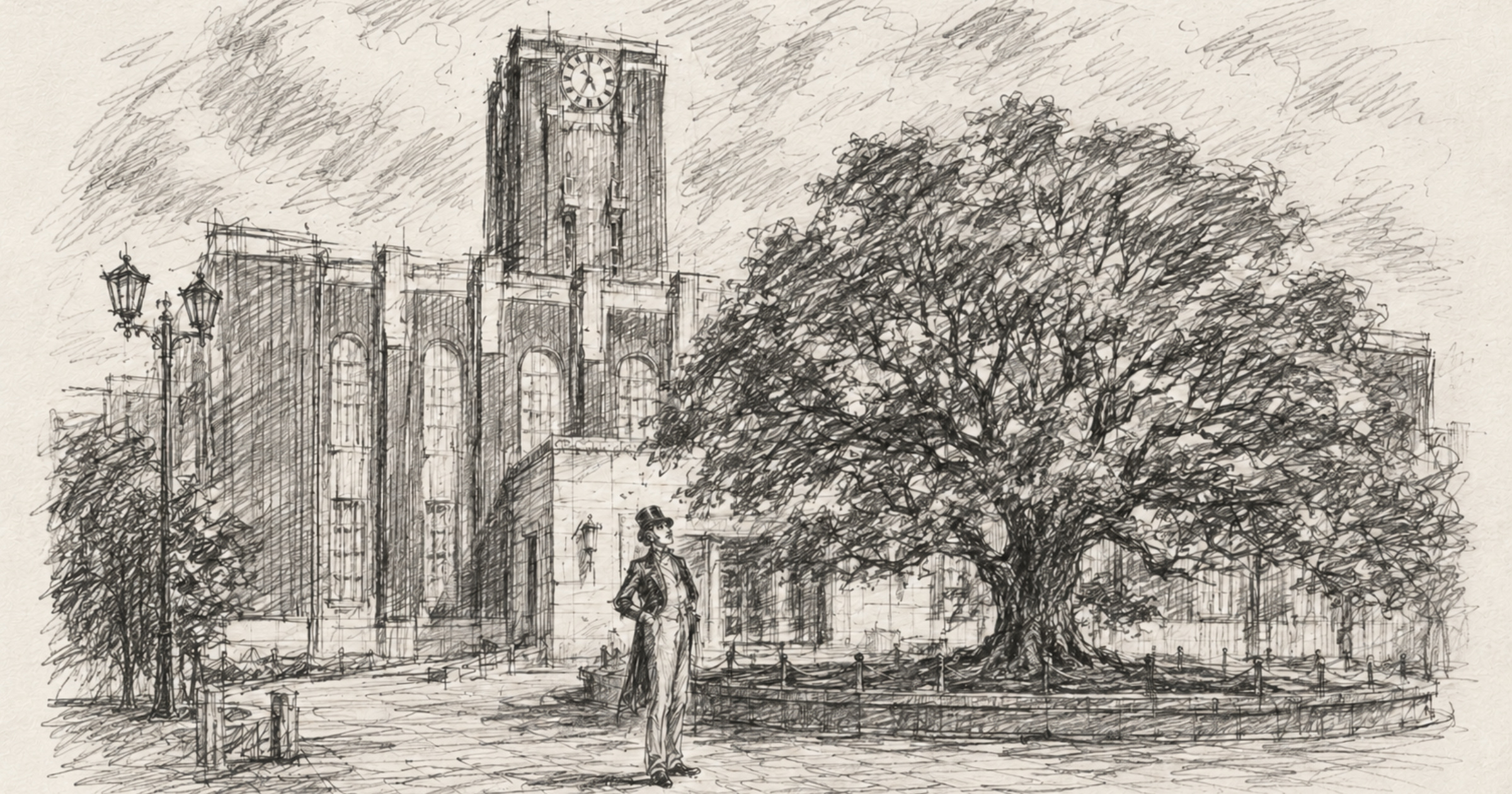
My future PhD advisor’s first question was not about research topics. It was: “How can I help you?”
I had walked into Prof. Toyoaki Nishida’s office at Kyoto University’s Graduate School of Informatics expecting a menu of pre-approved projects to choose from. Instead, I got the academic freedom the university is famous for… and the existential vertigo that comes with it. I had to sit in the discomfort of not knowing until a question surfaced that actually welled up from my own internal chemistry. I only understood what that moment had given me years later, and oddly enough, the thing that helped me see it was a video I almost did not watch.
Recently I was skimming a Kyoto University alumni newsletter and clicked on a public lecture by a young philosopher, Yoshihiro Tanigawa, on learning and “impulse” in the age of AI. My conversational Japanese is decent; I can enjoy a variety show, a Studio Ghibli movie or even a manzai routine without much trouble. But a philosophy lecture lives in a different register, and that is where my vocabulary thins out. Tanigawa’s delivery was colloquial enough, yet the words themselves were the obstacle, one unfamiliar term after another. The thought of pasting the transcript into a translation tool occurred to me in the first minutes. I let it pass. Something in the delivery held me, the cadence, the colloquial warmth, even the strangeness of the words I could not catch, and reaching for the tool felt like it would break a flow I was enjoying without being able to say why. He even opened by saying the whole talk was in its title, so we could relax and stop listening at any point as long as we held onto that. The joke was on me. I had not caught the full title. What I had was “For learning, you need neither… nor motivation,” with a hole where the first thing belonged. I could not follow sentence by sentence, so my brain did something else: it mapped the fragments I could catch onto the nearest concepts I already held.
That friction was generative in a way I did not expect. Failing to follow the lecture cleanly sent my mind on a series of associative jumps, a kind of Lévy flight: mostly small hops, with the occasional leap to something far away. When Tanigawa described people searching inside themselves for an answer that was not there, I thought of Albert Camus and the absurd, the mismatch between our demand for meaning and a world that does not supply it. His example of career orientation, the child who likes cake and concludes he should run a bakery, struck me as a ladder of inference in miniature, a grand conclusion extrapolated from a sliver of experience; that pulled in Paul Watzlawick’s traps of interpretation, which I tend to file alongside Chris Argyris’s ladder. From there it was a short hop to Nassim Taleb’s narrative fallacy, the way we connect dots into a story that satisfies us even when the line we draw does not match reality. And by the end of the lecture I had landed on Scott Galloway’s advice to follow talent rather than passion: Galloway has financial success in mind and Tanigawa something more philosophical, but the actionable counsel comes out nearly the same. Each leap felt slightly reckless. As new fragments came through clearly, they did the work of filtering, pruning the connections that did not hold and keeping the ones that did. The process was almost Bayesian: provisional guesses, revised against incoming evidence.
Afterward, I looked into Tanigawa’s work and found the poet John Keats and his idea of “negative capability”: the capacity to remain in uncertainty, mystery, and doubt without irritably reaching after fact and reason. Keats put it in a few lines of an 1817 letter to his brothers, and it turned out to be the thread connecting all those scattered associations. I also ran the transcript through a translation tool and read the lecture properly. That is when the irony landed: had I understood it perfectly the first time, I might have made almost none of those connections. And here Tanigawa’s framing, learning in the age of AI, catches up with me: the translation tool gave me in minutes what fluency would have given me upfront, the shortcut. AI now offers that shortcut on demand, in ever more contexts, which is exactly why the friction I stumbled into is becoming something one has to choose deliberately.
This is not the tidy claim that fluency is bad. A fluent listener could watch Tanigawa and make leaps too, they just would not be forced to. What my missing fluency removed was the shortcut. Perfect comprehension lets you categorize fast and move on, without ever fearing you have oversimplified. The gaps took that option away. The friction of the unknown, and the wish to get it right, pushed my mind into cautious, plural, creative leaps it would otherwise have skipped.
There is a second irony here. Tanigawa warns that when we ask ourselves what we want to do, we are forced to pick from a very limited hand of cards, the options already within arm’s reach, and he treats that constraint as a trap. Straining to follow him, I was doing exactly that: reaching for the nearest concepts I already held. But in this case the limited hand was not a trap, it was the tool. The few cards I happened to hold were what let me make sense of the fragments at all.
Which brought me back to Nishida’s question. What stayed with me was not only the freedom, it was being made to sit in the not-knowing until something real took form. He created the conditions for what Tanigawa, borrowing from the philosopher Charles Taylor, calls the “porous self”: a self with openings, structurally continuous with the world. He did not hand me a self, he opened one; his question let the world blow through, and a research question I could not have chosen from my limited hand of cards formed in the draft.