The Difficulty Is the Form
Recently I wrote about a strange piece of luck: failing to understand a Japanese lecture cleanly, and finding that the gaps in my comprehension pushed my mind into connections fluency would have let me skip. I argued that friction can be creative, and that in an age when AI offers frictionless answers on demand, the friction we used to stumble into is becoming something we have to choose on purpose.
I thought I had finished with the idea. Then my parents called from Tours.
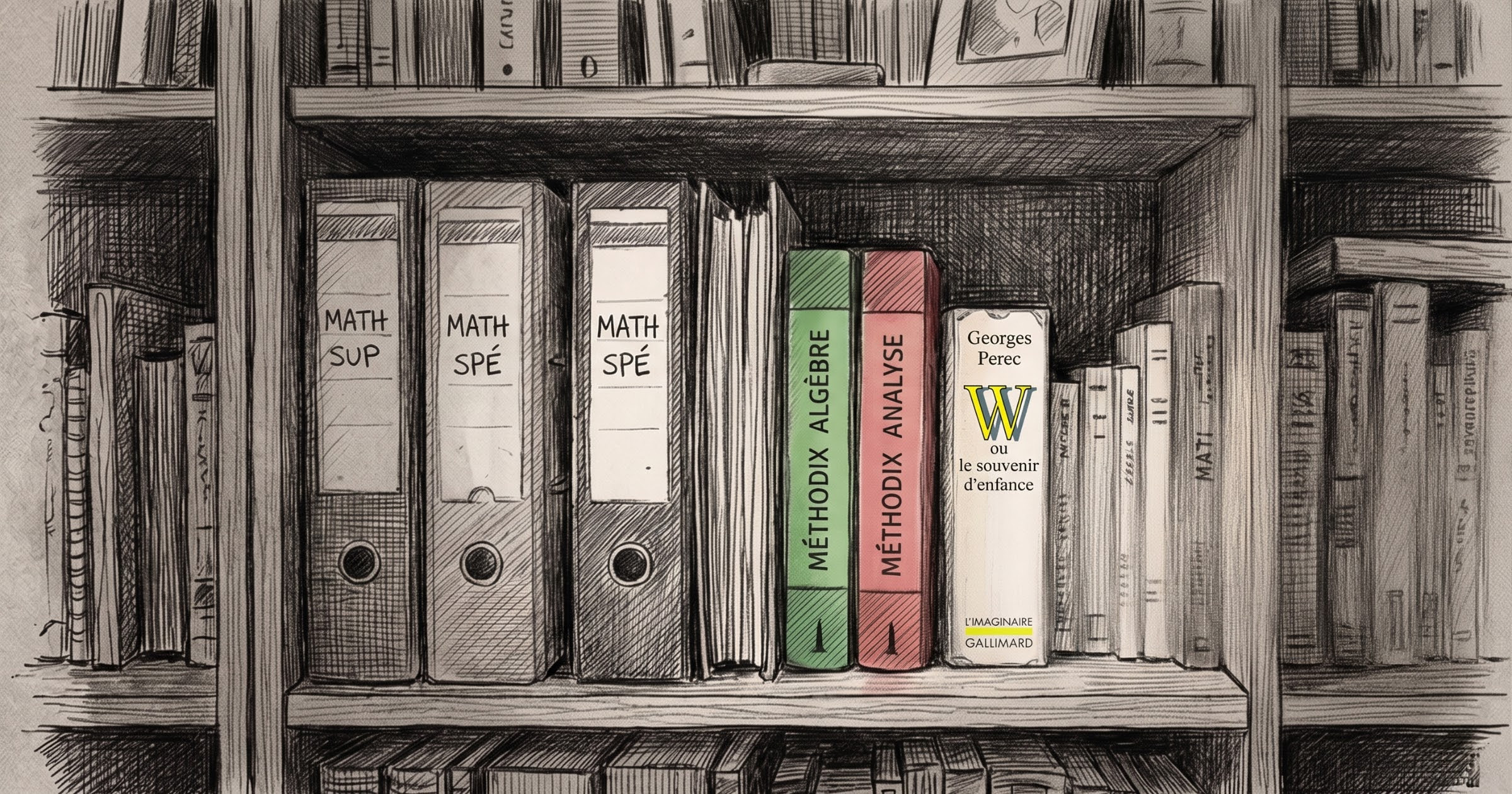
They are emptying my late grandparents’ house, where my mum lived as a child and where, well over two decades ago, I lived through my prépa years at the Lycée Descartes. There is a room there that still holds all of it: the Math Sup and Math Spé folders, the photographs, the books. On the phone they turned the camera toward a shelf and asked what I wanted to keep. To them it was clutter. To me it was perfectly ordered. I could see the spines I valued, the green and red MéthodiX among them, and the books from my French classes, and then one spine I did not expect to feel anything about, and felt everything about.
It was a small Proustian moment, the past arriving uninvited through a phone screen. The book was Georges Perec’s W ou le souvenir d’enfance, which we studied the year he was on the curriculum. Seeing it again returned, intact, the discomfort it gave me then. I had started reading it unsuspectingly, knowing Perec only as a maker of puzzles, and for a while I took its strange island for what it appeared to be; an orderly place, built on clear and admirable values. The recognition of what the island actually was came later, slowly, and with a kind of horror I have never quite shaken. I will not describe it here. The book withholds it too, for as long as it can, and that withholding is the point.
What struck me, looking at the spine through the camera, was that the unease it gave me then was the book working exactly as designed. Perec does not state the thing. He encodes it, in an alternating structure, in a blank page at the centre, in a constraint so complete that the horror reaches you only once you have been made complicit in not seeing it. The difficulty is not superimposed on the subject. The difficulty is the only form in which the subject can be approached at all. There are things that cannot be said directly, and for which a constraint is not an obstacle to expression but its sole available route.
This is the same idea I had just published, met from the far side. My friction was accidental and amateur; Perec’s was deliberate and total. But the mechanism rhymes: in both cases, the indirect path reaches what the direct one cannot.
It returns me to John Keats’s negative capability, the capacity to dwell in uncertainty and mystery without reaching irritably after fact and reason, which was the thread of my first essay. For Keats it was a stance the poet chooses; for Perec it was imposed, a Camusian absurdity he could not escape. His constraints are the only way to build a form around an absence that could not be resolved.
And this is also the part my first essay missed. I had too hastily framed the need for conscious friction as a response to AI, a discipline for our moment. But Perec was writing in the early 1970s, with a pen, when today’s AI-as-frictionless-companion was science fiction. He belonged to the Oulipo, the workshop of writers founded in 1960 who built constraint into a method: write a novel without the letter e, compose under rules chosen precisely because they block the easy phrasing and force the mind off its default track. They manufactured it, on purpose, because for the Oulipians, ease was the enemy of discovery.
The Oulipo gave the impulse a name and an institution, but the sensibility was older than the group. Raymond Queneau, who co-founded it, had already published Exercices de style in 1947, more than a decade before there was an Oulipo to claim it. The book takes one utterly trivial anecdote, a small altercation on a bus, and retells it ninety-nine times under ninety-nine different constraints: as a sonnet, in alexandrines, as legal jargon, as opera, as abuse, as slang. Nothing is added to the content. The event stays as dull as it began. What multiplies is everything the constraints generate. The same nothing, run through ninety-nine frictions, becomes ninety-nine genuinely different things. It is the clearest demonstration I know that the constraint does not limit creativity… it produces it.
There is a final turn, and it loops back to where my first essay began. A book whose entire substance is its form ought to be untranslatable: there is no stable content underneath to carry across. And yet Exercices de style has been translated again and again: into English, German, Italian, and many more, the Italian by Umberto Eco. It can only be done by refusing the translator’s usual tool. You cannot render the sentences faithfully, because the meaning is not only in the sentences; it is in the operation being performed on them. You have to re-perform the constraint, invent fresh variations, write your own ninety-nine. Barbara Wright’s celebrated English version succeeds precisely because she recreated rather than transcribed. Queneau, who reportedly said this was the book of his that he most wished to see translated, congratulated her with a line: “I have always thought that nothing is untranslatable. Here is new proof.”
An even more vivid instance is perhaps La Disparition, where the letter e is never used. Queneau’s constraints are additive, he piles on styles; whereas Perec’s is subtractive, he removes a foundation of the language itself. And yet it has been translated into various languages, the quintessential case of re-performing the constraint to carry the substance across. Perec’s devastating constraint has even been recreated in Japanese, where Shuichiro Shiotsuka excluded the entire i-dan (the i-vowel row) of the Japanese syllabary.
It is the kind of translation that bridges entirely different worlds. Fittingly, I did not discover Exercices de style in a French classroom in Tours. I discovered it in front of a coffee machine in Kyoto, when my buchō—my department head—held up an English and a Japanese copy of the book, asking me if, as a Frenchman, I knew about it. I did not. I ordered it in both English and French the same evening.
That memory now feels like the whole argument in miniature. Translation was not the removal of difficulty between French, English and Japanese; it was the creation of a passage through difficulty. AI will keep getting better at removing friction, and often we will be grateful for it. But some meanings do not survive the shortcut. They have to be approached obliquely, under constraint, through the long way round. Sometimes the detour is not a failure of understanding. It is the only form understanding can take.